A Gold Coast concreting business grew from a handful of blokes to more than forty, and the owners kept running into the same three problems. A systems problem, a recruitment problem and a culture problem. They brought me in to fix all three. I said four months. This is what we built.
The client
An eight-figure business running on email, text messages, pen and paper isn't a business. It's two managers' 24/7 job, one sick day away from total disruption. And it's not uncommon in the trades. It works when you're six people and the owner knows everything. It stops working somewhere past twenty.
The crew was the biggest risk in the business. Whole family groups would walk at once to start their own slab work. There was no way to screen for the right people before they were on site, no read on how a crew would gel, and the knowledge of how to manage each person lived only in the owners' heads. A bad hire can run past a hundred thousand dollars once you count the rework and the job that falls over. And when you feel you can't get better, you keep the crew you've got.
Quoting first. Ten hours to ten minutes.
Before the crew, the quotes. The business was putting out around 3,700 quotes a year, and some of them took ten hours to produce by hand. So the first thing I did was put AI to work on the quoting, using the pattern in their own past jobs, and teach the team to use it. Quoting went from ten hours to ten minutes.
That was the proof that bought the trust for the bigger job. It also set the rule I've used ever since. Start with the one problem costing the business the most time each week, and make it work before you touch anything else.
Then the crew
Keeping a good crew is the hardest part of concreting. So I brought two things together. Twenty years of building brands and cultures, and DISC psychographic profiling, which I'm qualified in and have used with teams for years. Every person in the business was profiled. Nobody got a label. What they got was a way to understand themselves, and each other, for the first time.
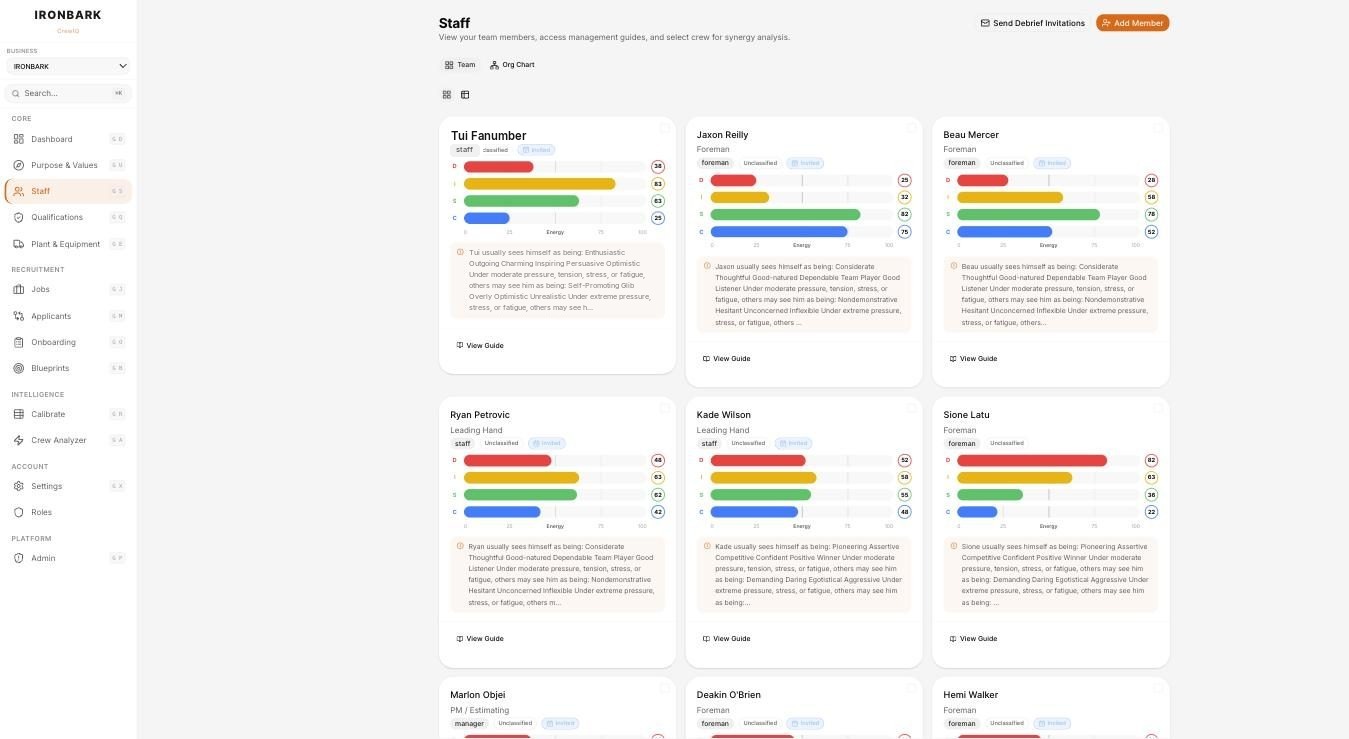
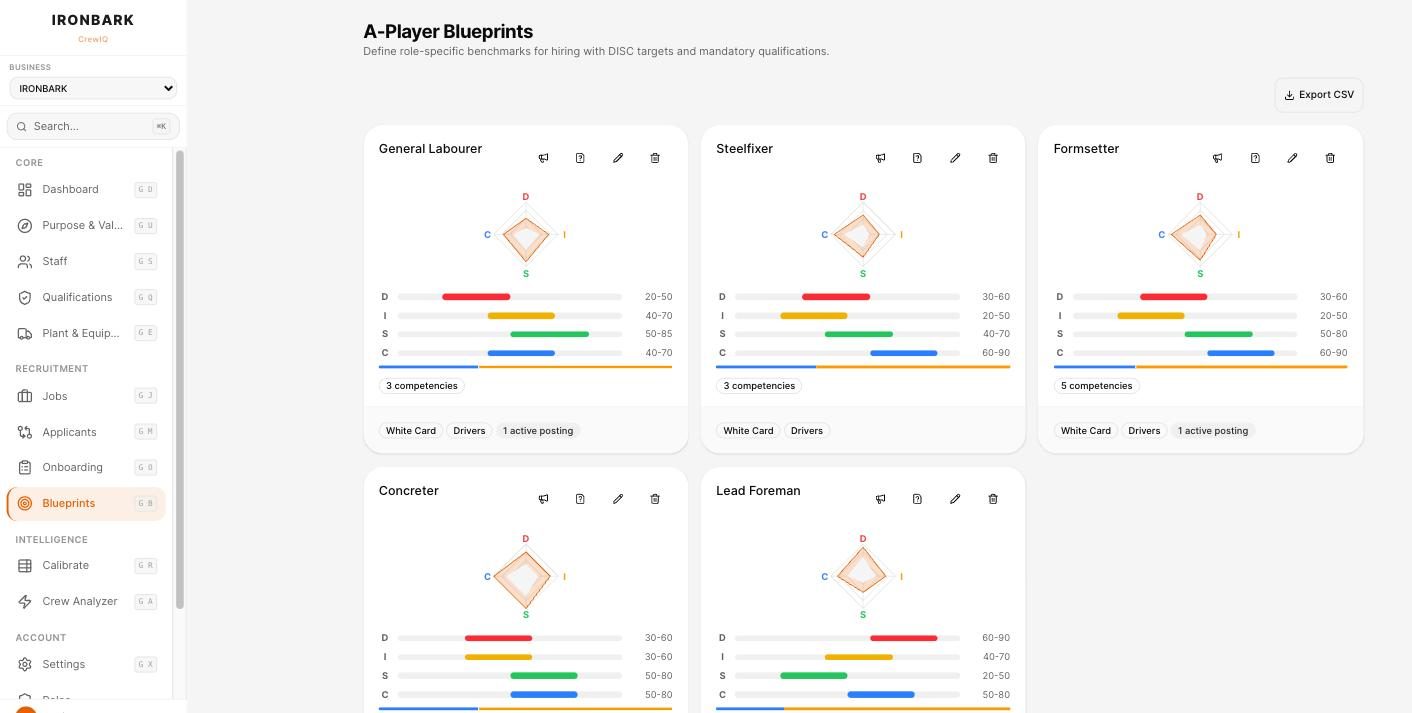
Then we looked at each type of job inside the business and worked out the blueprint for it. The behavioural range that actually performs on their sites, plus the tickets that are non-negotiable. "Hire more like Jake" became a measurable standard instead of a hunch.
Hiring to a standard
We put one ad on Seek, $600 instead of the $6,000 they'd been paying, and pointed every applicant at our own job board. The application is built to be finished in five minutes on a phone, and the moment it's submitted the system takes over.
- The owner is notified the moment an applicant lands. No logging in to check. No good applicant sitting in an inbox for a week while a competitor hires them.
- Screening questions do the first cut. The non-negotiables for the role, answered before anyone spends a minute on the phone.
- A light DISC assessment scores fit against the blueprint. A few minutes of questions, and the applicant is scored on how their behavioural profile sits inside the range that performs in that role. A hard-charging go-getter applying for a steady, detail-driven concreter seat shows up in the score before anyone books an interview.
- References get texted automatically. Nobody in the trade checks references because Seek charges extra for it on every job. CrewIQ texts each referee a link to score the applicant on the competencies for that role. Sixty seconds, a few taps, done. No reply in 48 hours and it chases them, then again at 96.
What comes out the other end is a scored shortlist against the blueprint. Behavioural fit, screening answers, tickets and reference scores, all on one screen. The software stops the owner sifting. The owner still makes the call.
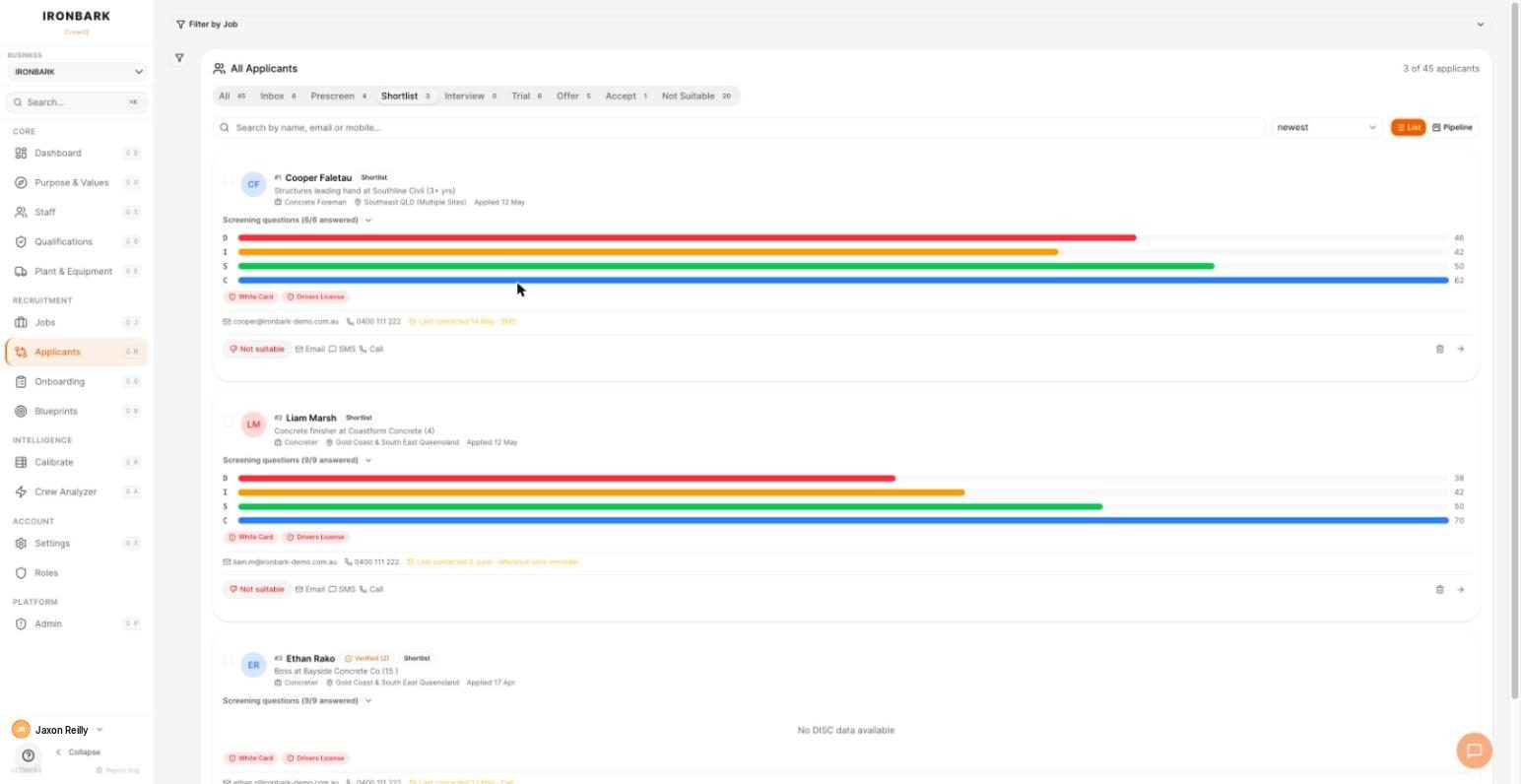
Then the interviews. Not a single concreter who came through had ever done a behavioural interview before. That's the step that separates the bloke who'll be there in a year from the one who won't, and the business had never had a way to run it.
Inducted before the first pour
Hiring the right bloke is half the job. The other half is making sure he understands how you work before he's standing on your site. Most trades businesses do this with a handshake, a hi-vis vest and "follow Jake". CrewIQ makes it a system.
A new hire gets a link on their phone the day they accept. Behind it is the company induction, built as short video modules or a slide deck, presented by the owners in their own words. Who we are, what we stand for, how we work, health and safety, high-risk work and plant, and the policies that aren't up for debate. Each section has to be watched before the next one unlocks.
Then the quiz, and it isn't a formality. The owner sets the pass mark, 100% by default, on the things that keep people alive and the business out of court. SWMS. Take 5 before you start. Stop Work Authority. PPE and exclusion zones around plant. Fitness for work. How to report an incident or a near miss. Fail it and you go back to the module. Pass it and it's time-stamped against your record.
- Tickets and licences on file before day one. White Card, licences, VOCs and high-risk work tickets uploaded from the phone, expiry dates tracked, and a nudge to the owner before one lapses.
- Site-specific inductions on top. Every site carries its own induction, emergency contacts and re-induction period. Subcontractors go through the same flow, and the supervisor approves or blocks them before they walk on.
- A record that stands up. Who watched what, who passed what, when, and who signed it off. When the regulator or the head contractor asks, the answer is a screen, not a shoebox.
The content is the owner's. We build the induction deck and the video with them, then load it once. Every hire after that gets the same induction, delivered the same way, whether the owner is on site or on holiday.
The hard conversations
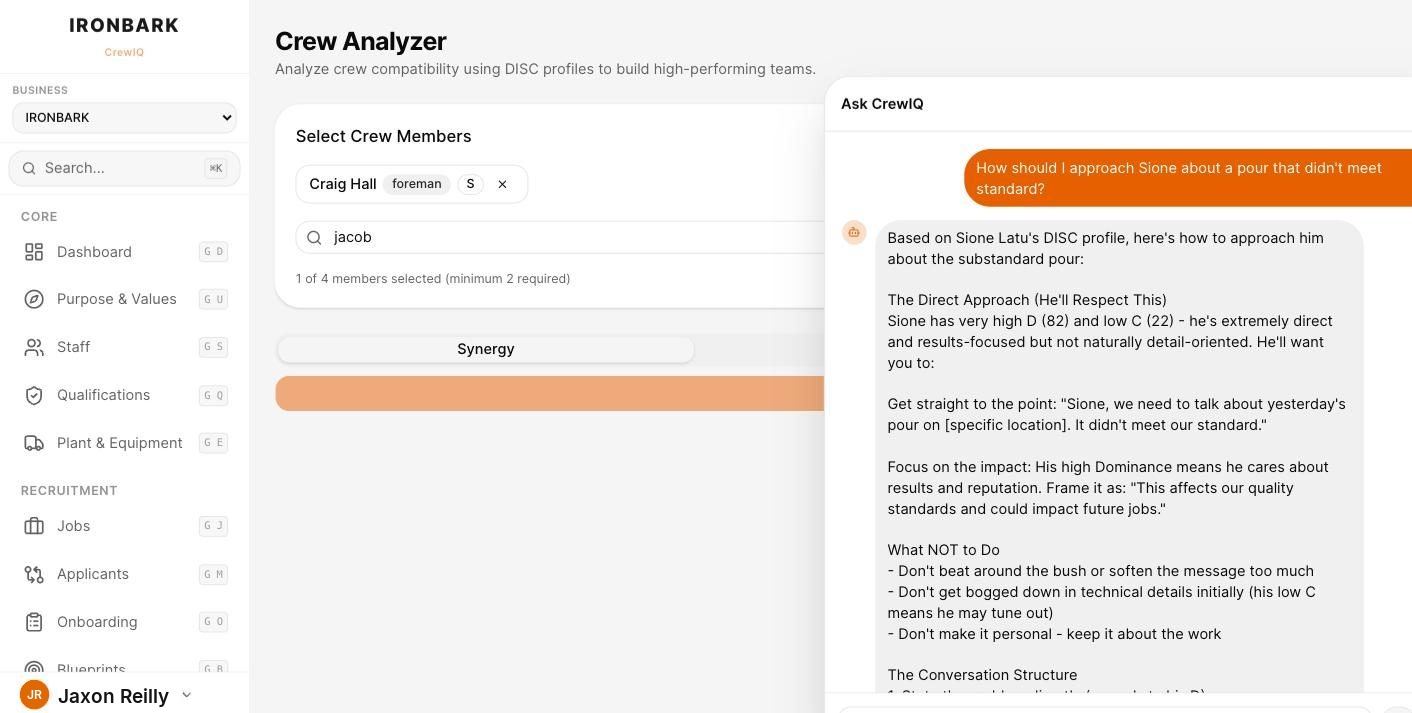
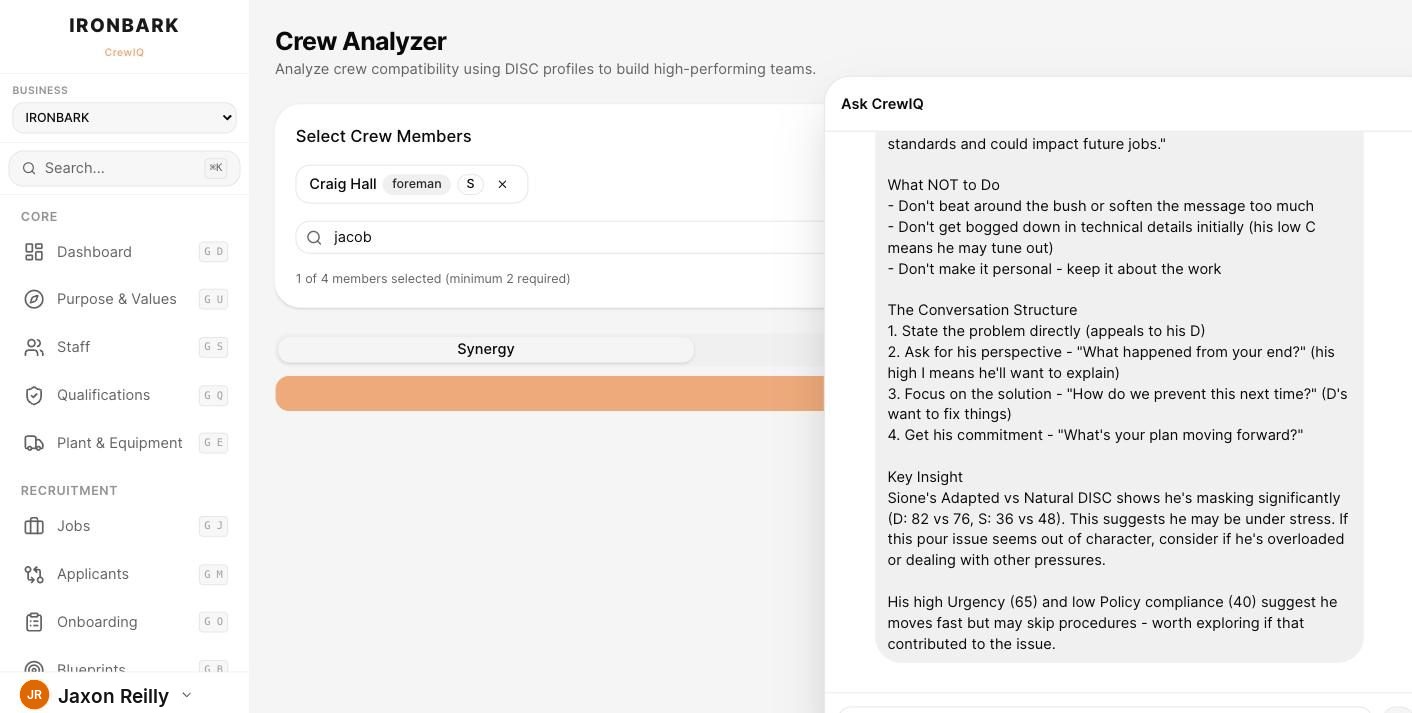
The part I'm proudest of is the coaching layer. Before a supervisor raises something tricky with a worker, he can ask how to approach it, and the answer is drawn from both people's profiles rather than generic advice. A fast-moving, direct supervisor pulling up a steady, detail-focused concreter about a pour that didn't meet standard gets coached to do it in private, lead with what the bloke does well, get specific about the fix, and make it about the standard rather than the person.
Same problem, handled so it lands. That's the difference between a bloke who fixes it and a bloke who walks.
Culture that survives the growth
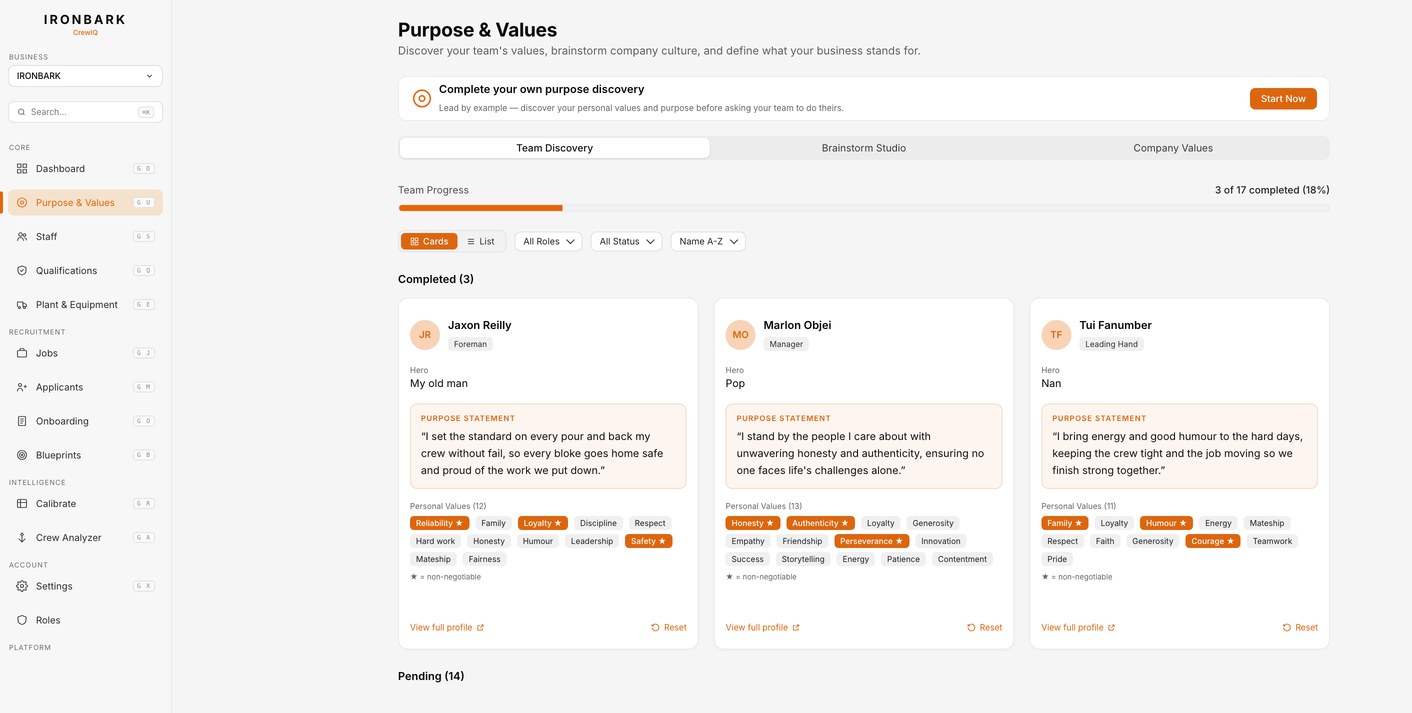
The last piece was purpose and values. Personal purpose for every team member, then shared company values, drawn from the method in my book and cut down to something a crew can do on a phone in a few minutes. The values that worked at six people don't survive to forty by accident. They have to be written down, and they have to be the owner's, not a poster.
I'll be honest about this one. The leadership team did the work and the values are set. Getting every bloke on the crew to do their own is the next push, and the system is there waiting for them.
Software with an expert in the loop
CrewIQ is the name it ended up with. It's not pure software and I won't pretend it is. The software surfaces and ranks. A human makes the people call. The profiling, the behavioural interviews and the culture work are done by a person who knows what they're looking at. That's the design, not a limitation, and it's the reason it works.
It's also theirs. It runs on their own accounts, and when they need to hire again, which they do right now because they're flat out, the system is already built and waiting. They're not starting from a blank ad on Seek.
Four months, in and out
The whole thing took four months, and the method is the same one I use on every build now. Talk it out. Describe the problem better than anyone else can, because if you can't articulate the problem, no amount of building will save you. Then diagnose where the time goes, draw the system, prove one piece of it, and build the rest one problem at a time.
I didn't hand them a heap of documents to put on a shelf. I left them with something that runs on a Monday morning without me.
If this sounds like your business
If you run a trades or construction business and your growth depends on who turns up, this is the work I do. Start with the problem costing you the most time. Then the crew.
Talk to Chris
Fifteen minutes. Where you are, what's eating your week, and whether we're a fit.
Talk to Chris →